



Introduction
Glock is one of the most recognized names in the world of firearms manufacturing, produced by the Austrian company Glock Ges.m.b.H. Since its founding in the early 1980s, Glock has built a strong reputation among police forces, military units, and civilian gun owners across the globe. Glock pistols are widely known for their simplicity, reliability, and durability. Among its many models is the Glock 26, and the Glock 26X is a crossover variant of it, built under the company’s “Slimline” and “Crossover” design concept.
In this article, we will cover everything about the Glock 26X in detail — its design, specifications, features, uses, pros and cons, and who it is best suited for.
What is the Glock 26X?
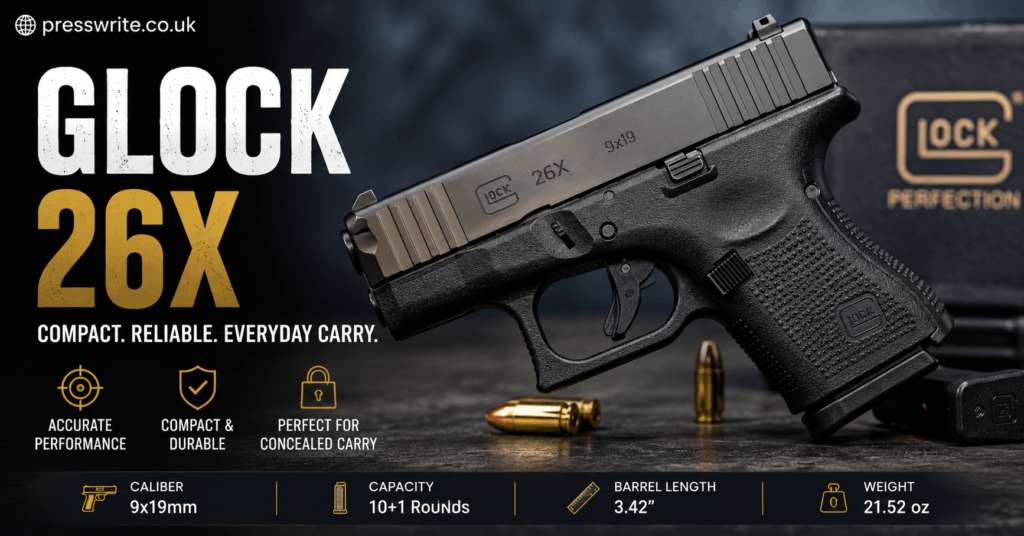
The Glock 26X is essentially a combination of two different Glock models. It uses the smaller, lighter slide of the Glock 26 (a subcompact pistol), while its frame (grip) is full-size, similar to the Glock 19X. This is exactly why it is called a “Crossover” pistol — it blends features from two different models into one.
The purpose behind this design was to give users a pistol that is easy to conceal but still offers a larger, more comfortable grip for better control while shooting.
History of the Glock 26X

Glock first introduced the Glock 19X model in 2018 for the U.S. Army’s Modular Handgun System (MHS) competition. Although the Glock 19X was not ultimately selected in that competition, the company released it into the civilian market, where it was well received. Following this success, Glock expanded its Crossover lineup and introduced models like the Glock 26X and Glock 45.
The Glock 26X was specifically designed for people who carry a firearm daily (Everyday Carry/EDC) and want a pistol that is lightweight yet offers a comfortable, full-size grip.
Design and Build
The biggest highlight of the Glock 26X is its hybrid design:
- Slide: It uses the subcompact slide of the Glock 26, which is smaller and lighter, making the pistol easier to conceal.
- Frame: The frame is similar to the Glock 19X, offering a full-size grip. This also increases magazine capacity and improves handling.
- Finish: It features Glock’s nDLC (nitride) finish, which provides resistance against corrosion and wear.
- Color: Most Crossover models come in a Coyote Tan color, giving them a distinct look compared to standard black Glock models.
Technical Specifications
The table below lists the key technical specifications of the Glock 26X:
| Feature | Details |
| Manufacturer | Glock Ges.m.b.H. (Austria) |
| Caliber | 9x19mm Parabellum |
| Type | Semi-automatic pistol |
| Barrel Length | Approx. 3.43 inches (87 mm) |
| Overall Length | Approx. 7.28 inches (185 mm) |
| Height | Approx. 5.04 inches (128 mm) |
| Width | Approx. 1.34 inches (34 mm) |
| Unloaded Weight | Approx. 26.28 oz (745 grams) |
| Magazine Capacity | 10 or 15 rounds (varies by region/model) |
| Trigger System | Safe Action System |
| Finish | nDLC (Nitride) Coating |
| Frame Color | Coyote Tan (typically) |
| Sights | Fixed polymer sights |
| Rifling | Right-hand, hexagonal (polygonal rifling) |
(Note: Exact figures may vary slightly depending on region, local laws, and model variation.)
Key Features
1. Safe Action System
Like all Glock pistols, the Glock 26X features the “Safe Action System.” This includes three built-in safeties — trigger safety, firing pin safety, and drop safety. This system keeps the firearm secure without requiring an external manual safety, as long as the trigger isn’t pulled.
2. Lightweight yet Durable Polymer Frame
Glock is well known for its polymer frame construction, which keeps the pistol light while remaining highly durable. The Glock 26X also uses this same reliable polymer material.
3. Advantage of the Crossover Design
A small slide combined with a large frame makes this pistol the best of both worlds — easy to carry and conceal, yet stable and comfortable during shooting.
4. Modular Backstrap
Like many other Glock models, the Glock 26X comes with interchangeable backstraps, allowing users to adjust the grip according to their hand size.
5. Low-Maintenance Design
Glock pistols are relatively easy to clean and maintain because they have fewer components and a simple, straightforward design.
Glock 26X vs Other Glock Models
| Model | Slide Size | Frame Size | Primary Use |
| Glock 26 | Subcompact | Subcompact | Concealed carry |
| Glock 19 | Compact | Compact | Duty / carry both |
| Glock 19X | Compact | Full-size | Duty + carry crossover |
| Glock 26X | Subcompact | Full-size | Compact carry + better grip |
| Glock 45 | Compact | Full-size | Duty / tactical use |
This table makes it clear that the Glock 26X is built on a “best of both worlds” concept, combining the advantages of a smaller slide with the stability of a larger frame.
Common Uses
The Glock 26X is primarily used in the following areas:
- Everyday Carry (EDC): Civilians who legally carry a firearm daily under license.
- Self-Defense: For home or personal protection.
- Law Enforcement (in some regions): Some police departments use it as a backup or off-duty weapon.
- Concealed Carry: Its smaller slide makes it well-suited for concealment under clothing.
- Sport Shooting: Also used by hobbyist shooters for range practice.
Advantages
- Lightweight design, making it comfortable to carry for extended periods.
- Full-size grip provides better control and reduces felt recoil.
- Higher magazine capacity compared to standard subcompact models.
- Reliable and rugged Glock engineering.
- Easy to maintain, with widely available and affordable spare parts.
- Smaller slide makes concealment easier.
Disadvantages
- Due to the full-size grip, it isn’t as slim as a purely subcompact pistol, which can make concealment under very tight clothing slightly harder.
- Limited availability — it isn’t easily found in every country or market.
- New shooters may need some time to get comfortable with the trigger pull and safety system.
- Pricing can be slightly higher than standard Glock models since it falls into a special/limited crossover category.
Price
The price of a crossover pistol like the Glock 26X varies depending on the market, country regulations, taxes, and dealer. Generally, such pistols are priced somewhat higher than standard Glock models internationally, since they fall under a special/crossover edition category. For exact and current pricing, it is always best to check with your local authorized dealer or licensed firearms retailer.
Legal Aspects
Before purchasing, owning, or using any firearm, it is essential to understand the relevant laws in your country and region. Most countries require a license, background check, and minimum age requirement before a firearm can be purchased. In countries like India and Pakistan, owning a firearm requires going through a specific licensing process, and the availability of imported pistols like Glock models depends on local regulations. Therefore, it is important to consult local authorities or licensing bodies before making any purchase.
Maintenance Tips
- Clean the pistol after every use, especially the barrel and slide.
- Use proper gun oil and lubricant.
- Regularly check the magazine spring for wear.
- Always store the pistol in a dry and secure location.
- Periodically inspect the firearm even during long periods of non-use.
Who Is the Glock 26X Best Suited For?
If you are someone who:
- Wants a compact yet stable pistol for daily carry,
- Prefers a larger grip for better shooting control,
- Values Glock’s proven and reliable engineering,
then the Glock 26X could be a great choice for you. However, if you’re looking for an extremely slim and small pocket pistol, the standard Glock 26 might be a better fit.
Conclusion
The Glock 26X is an interesting example from Glock’s Crossover lineup, combining a subcompact slide with a full-size frame to create a well-balanced pistol. It is designed for users who want both ease of concealment and stability while shooting. Its rugged build, Safe Action System, and Glock’s trusted engineering make it a reliable option. However, before purchasing any firearm, it is mandatory to follow local laws, licensing procedures, and safety regulations.