
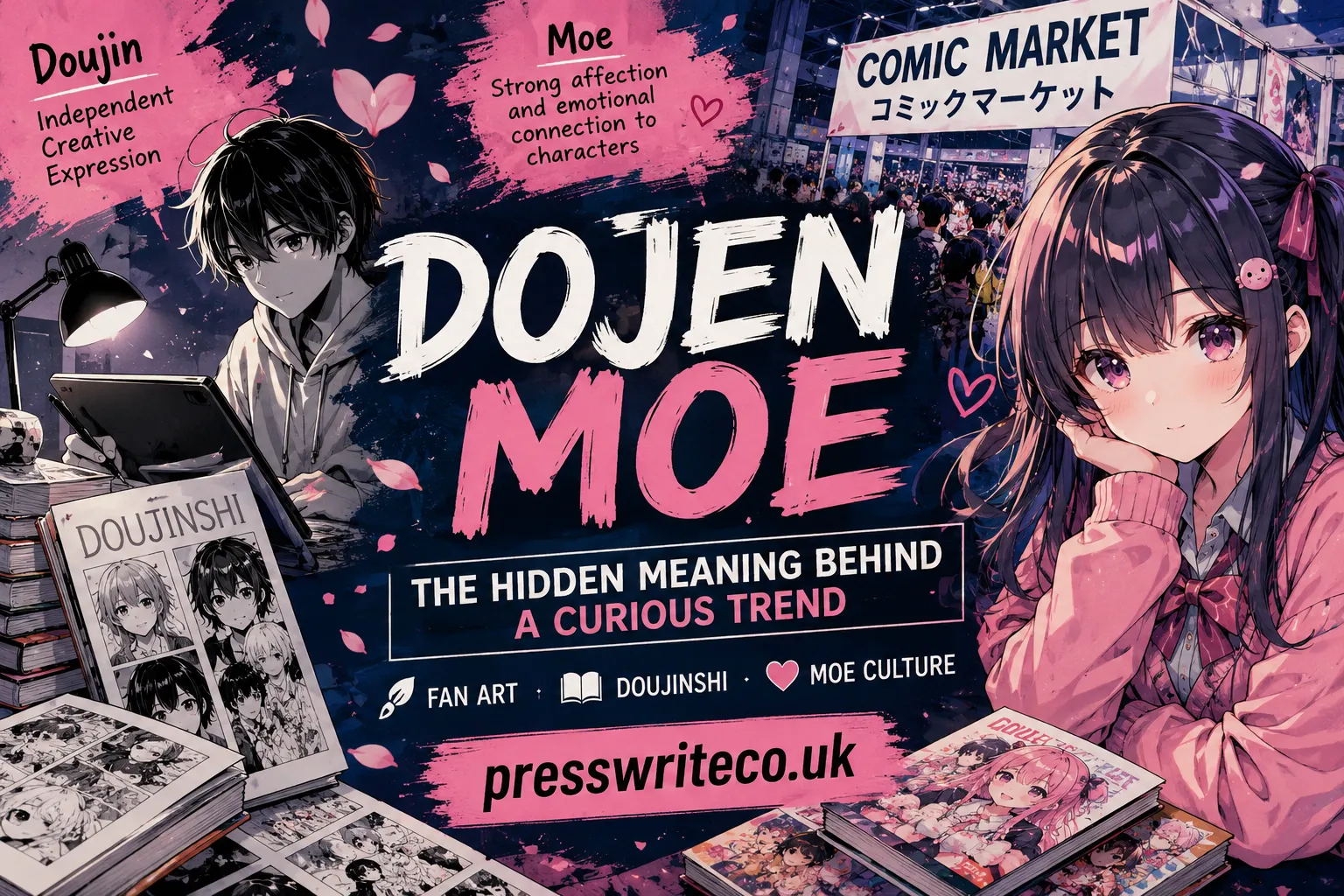
If you have recently searched for dojen moe, you may have noticed something unusual: different websites seem to explain the phrase in different ways. Some connect it with anime, fan art, independent creativity, or character-focused aesthetics, while others describe it as a modern internet expression.
That uncertainty is important.
Unlike established Japanese pop-culture terms such as doujin and moe, the exact phrase “dojen moe” does not have a widely documented, universally accepted definition. Current search results largely consist of recent explanatory articles, and those articles do not agree on a single origin or meaning.
For that reason, the most useful way to understand dojen moe is to separate the established cultural concepts behind the phrase from the newer, less certain internet usage.
This guide explains the possible meaning of dojen moe, the difference between dojen and doujin, what moe actually means, how doujin culture developed, why the phrase appears online, and how readers can evaluate claims about it without confusing internet speculation with established Japanese terminology.
What Is Dojen Moe?
Dojen moe is best treated as an informal or internet-based phrase rather than a formally established Japanese cultural term.
Online explanations commonly associate the phrase with two concepts:
- Doujin — independent or self-published creative work and communities.
- Moe — an emotional response or strong attachment to fictional characters or appealing character traits.
The combination can therefore be used informally to describe fan-created or independent creative material with a strong emotional or character-focused appeal.
However, that interpretation should not be presented as an official dictionary definition. Searches for the exact phrase produce conflicting explanations, with some websites calling it a hybrid term and others describing it as an SEO-created or unclear keyword.
This distinction matters for readers who want reliable information.
The phrase dojen moe may appear frequently online, but repetition alone does not establish a term as authentic Japanese vocabulary. A responsible explanation should distinguish between what is documented and what is inferred.
Quick Facts About Dojen Moe
| Topic | What the evidence suggests |
| Exact phrase | Not a widely established Japanese term |
| “Dojen” | Likely related to or confused with “doujin” |
| “Moe” | Established Japanese pop-culture slang |
| Doujin | Established concept connected with independent creative activity |
| Anime connection | Possible through doujin and moe culture |
| Official genre | No strong evidence that “dojen moe” is one |
| Online usage | Increasingly discussed by websites and search-focused content |
| Best interpretation | An informal phrase requiring context |
Understanding this distinction gives us a stronger foundation for exploring the subject.
Why the Spelling “Dojen” Matters
One of the first clues to the mystery surrounding dojen moe is the spelling itself.
The established Japanese term is generally romanized as dōjin or doujin, associated with the Japanese word 同人. “Dojen” is not the standard English romanization normally used when discussing doujin culture.
This means that “dojen” could represent several possibilities:
- A spelling variation.
- A phonetic interpretation.
- A search-engine query created by users.
- A typo that became repeated online.
- A newly constructed internet keyword.
- Confusion with another name or website.
Recent web pages discussing the keyword frequently make this connection between “dojen” and “doujin,” although they disagree about exactly how the phrase originated.
This is a useful lesson in internet research: a keyword can become visible without having a long-established cultural history.
When many websites publish pages targeting the same unusual phrase, search engines may begin returning more results for it. That visibility can make a phrase appear older or more authoritative than it actually is.
So, if someone asks, “Is dojen moe an official Japanese word?” the safest answer is there is not enough reliable evidence to treat it as one.
What Does Doujin Really Mean?
To understand the likely background of dojen moe, it helps to examine doujin itself.
Doujin culture has a genuine and well-documented history in Japan. It broadly relates to people who share interests and create or publish works independently. In modern popular culture, the word is especially associated with independently produced manga, comics, games, novels, illustrations, music, and other creative works.
One of the strongest examples is Comic Market, commonly known as Comiket.
According to the official Comic Market history, the first Comic Market took place on December 21, 1975. It was created partly because existing manga fan events offered limited space for experimental and diverse creative expression. The original event involved only 32 circles and around 700 participants.
Over the decades, that culture expanded dramatically.
The official Comic Market describes its event as a marketplace dedicated to doujinshi and independent creative expression. Its current materials also describe Comic Market as a major marketplace centered around manga, animation, games, comics, and related forms of self-expression.
This history gives us something concrete.
Unlike “dojen moe,” doujin culture is not merely an internet invention. It has a documented connection to Japanese fan creativity and independent publishing.
What Is Doujinshi?
A particularly important word is doujinshi.
Doujinshi are independently produced publications. They may include:
- Manga
- Short comics
- Fiction
- Illustrations
- Essays
- Fan works
- Original stories
- Experimental creative projects
Not every doujinshi is fan fiction, and not every doujin work is based on an existing commercial franchise.
Some creators produce original characters and original worlds, while others create works inspired by existing anime, manga, games, or other media.
This creative independence is one reason doujin culture became important within Japanese fan communities.
Comic Market’s own history emphasizes personal creation, communication among fans, and freedom of creative expression.
That background is essential when interpreting online claims that connect “dojen moe” with independent anime-style creativity.
What Does Moe Actually Mean?
The second major part of the phrase is moe.
Unlike “dojen moe” as a combined expression, moe is a documented Japanese pop-culture term.
The Japanese dictionary entry from Shogakukan, reproduced through Goo Dictionary, describes 萌え (moe) as slang referring to strong feelings of attachment, passion, or desire toward a person or thing. It also explains that the term began being used among manga and anime enthusiasts around the early 1990s and that it does not have one perfectly fixed definition.
That last point is particularly interesting.
Even an established term like moe can be difficult to define with one simple sentence.
Academic research similarly describes moe as a somewhat nebulous concept connected with the appeal of fictional characters in anime and manga. A University of British Columbia publication notes that scholars have struggled to establish one universally satisfactory definition.
Another academic discussion explains moe as an affective response to fictional characters and character features. In other words, the emotional response occurs in the viewer or fan rather than simply existing as an objective property of the character.
Moe Is More Than “Cute”
It is tempting to translate moe simply as “cute.”
That is incomplete.
A character can produce a moe response because of qualities such as:
- Innocence
- Vulnerability
- Kindness
- Personality
- Shyness
- Emotional sensitivity
- Particular visual traits
- A memorable mannerism
- A comforting relationship with other characters
The response can be affectionate, emotional, protective, enthusiastic, or otherwise deeply connected to the character.
Academic work on contemporary Japanese media culture also discusses kyara-moe, describing affective responses to attractive elements associated with characters, including visual traits, costumes, gestures, and situations.
Therefore, when people connect “dojen moe” with character-focused fan creativity, the moe part is usually pointing toward this emotional dimension.
How Doujin and Moe Can Connect
Now the two established concepts become easier to understand.
Doujin relates primarily to independent creative activity and communities.
Moe relates to emotional attachment or appeal associated with fictional characters and certain character traits.
When these ideas overlap, creators may produce independent works designed around characters, relationships, emotions, aesthetics, or fan interpretations.
For example, an independent artist might create:
- A fan comic focused on a favorite character.
- An original character illustration.
- A short story exploring a character relationship.
- A small visual novel.
- A self-published art collection.
- A character-centered game.
- A fan-created anthology.
Some of these works may strongly appeal to audiences interested in moe aesthetics.
That overlap makes the phrase dojen moe understandable as an internet description.
But there is an important distinction:
The existence of doujin culture and moe does not automatically prove that “dojen moe” is an official name for a specific movement.
That is where many low-quality explanations become misleading.
Is Dojen Moe an Official Anime Genre?
There is currently no strong evidence that dojen moe is an officially recognized anime genre.
Established anime and manga terminology generally has clearer historical usage, Japanese-language documentation, community usage, or academic discussion.
The exact phrase “dojen moe,” by contrast, appears mainly in relatively recent web articles that offer different interpretations of the term. Some describe it as a fusion of doujin and moe, while others explicitly call it an internet-generated keyword.
That does not mean people cannot use the phrase creatively.
Internet communities constantly create new labels.
A term can begin as:
search query → community expression → repeated article language → recognizable online label
But that process is different from a traditional Japanese cultural term developing organically over decades.
For SEO writers, this distinction is especially important because search visibility should never replace factual verification.
Why Is Dojen Moe Appearing Online?
There are several reasonable explanations for the increasing visibility of dojen moe.
Search Curiosity
Unusual keywords naturally create curiosity.
When users see an unfamiliar phrase, they search for:
- Meaning
- Origin
- Definition
- Examples
- History
- Cultural context
That creates demand for explanatory content.
Anime’s Global Reach
Anime, manga, gaming, fan art, and Japanese pop culture have global audiences.
As these communities grow internationally, Japanese terms are often transliterated, shortened, misspelled, or combined with English expressions.
A phrase that would be unusual in native Japanese usage can therefore circulate among international internet users.
SEO Content
Another factor may be search-engine optimization.
A low-competition phrase can attract publishers because it may be easier to rank for than a highly competitive keyword.
Several recent pages now specifically target “dojen moe,” despite offering different explanations.
This does not prove that every page is inaccurate.
It does mean readers should look for evidence instead of assuming that multiple websites repeating a claim automatically makes that claim true.
Common Misunderstandings About Dojen Moe
The phrase creates several predictable misunderstandings.
“Dojen Moe” Is a Famous Japanese Word
There is insufficient evidence to make this claim.
The safer description is that it is an unclear or informal online phrase associated by some writers with doujin and moe concepts.
It Is a Specific Anime Genre
Again, there is no strong evidence supporting this classification.
It may be used descriptively, but that is different from being an established genre.
It Means All Anime Fan Art
Not necessarily.
Doujin culture is broader than fan art. It can include original creations, publications, games, music, novels, and many other forms of expression.
Moe Simply Means Cute
That is an oversimplification.
The established Japanese usage involves emotional attachment or strong positive feelings and can involve much more than surface-level appearance.
Repeated Search Results Prove the Term Is Official
They do not.
Search results demonstrate that people are publishing or searching for a phrase. They do not automatically establish linguistic authenticity.
Dojen Moe vs. Doujin and Moe
The easiest way to avoid confusion is to compare the terms directly.
| Term | Status | General idea |
| Dojen moe | Unclear/informal online phrase | Often interpreted through doujin + moe |
| Doujin | Established Japanese concept | Shared-interest and independent creative activity |
| Doujinshi | Established term | Independently produced publications |
| Moe | Established Japanese slang | Strong affection or emotional attachment |
| Anime | Established medium/category | Japanese animation and related global culture |
| Fan art | Broad creative category | Art created by fans around characters or media |
This comparison shows why dojen moe should be handled carefully.
The components are real, but the combined phrase has a much less certain status.
What Kind of Content Might Be Associated With It?
When people use dojen moe as an informal label, they may be talking about creative material with several overlapping qualities.
Possible examples include:
- Character-focused illustrations
- Fan-made manga
- Independent comics
- Emotional short stories
- Anime-inspired artwork
- Original character designs
- Self-published books
- Independent visual novels
- Fan communities
- Character-centered digital projects
However, these are examples of the broader cultural territory, not a formal checklist for defining dojen moe.
A creator does not need to use the phrase to participate in doujin culture.
Likewise, a work does not automatically become “dojen moe” simply because it contains a cute anime-style character.
Context remains important.
Copyright and Responsible Fan Creativity
Any discussion of fan-created work should also consider copyright.
Doujin culture has a complicated relationship with existing intellectual property because creators may produce works inspired by commercially owned characters and franchises.
That does not mean every fan creation is automatically legal or illegal.
Copyright rules vary according to jurisdiction, the specific work, the rights holder, the nature of the use, and other circumstances.
The responsible approach is therefore simple:
- Respect the original creator.
- Check the applicable copyright rules.
- Follow platform policies.
- Avoid presenting someone else’s work as your own.
- Do not assume that “fan-made” automatically means “free to use commercially.”
- Credit creators where appropriate.
- Obtain permission when required.
Comic Market itself emphasizes that its activities operate within the constraints of Japanese law while supporting freedom of expression.
This is another reason not to reduce doujin culture to a single aesthetic label.
It is a much broader creative ecosystem.
How to Research Dojen Moe Properly
If you encounter dojen moe on a website, social platform, or forum, use a simple verification process.
Check the Spelling
Look for related forms such as:
- Doujin
- Dōjin
- Doujinshi
- Moe
- Dojin
This can reveal whether the original query may have resulted from a spelling variation.
Find Primary or Authoritative Sources
For doujin history, official Comic Market material is much stronger evidence than an anonymous blog post. Comic Market documents its history beginning in 1975 and explains its role in independent creative culture.
For the meaning of moe, Japanese-language dictionary material and academic research provide better evidence than SEO articles.
Compare Multiple Sources
If ten websites give exactly the same definition but none provides a primary source, repetition should not be confused with verification.
Look for:
- Japanese-language sources
- Academic publications
- Official organizations
- Dictionaries
- Documented historical records
- Named authors and references
This approach is especially valuable when researching emerging internet terminology.
Why E-E-A-T Matters for This Topic
The topic of dojen moe is a good example of why E-E-A-T principles matter in SEO content.
E-E-A-T refers to:
- Experience
- Expertise
- Authoritativeness
- Trustworthiness
A high-quality article should not simply repeat whatever appears on the first page of search results.
Instead, it should distinguish evidence from interpretation.
For this topic, that means explaining the uncertainty around the exact phrase while providing reliable background about the terms that can actually be documented.
For example, the official Comic Market history provides first-party evidence for the development of doujinshi culture.
Japanese dictionary material provides a documented explanation of moe.
Academic sources provide additional context about how scholars understand moe and character appeal.
That combination creates a stronger article than simply declaring that dojen moe is a famous anime genre.
Frequently Asked Questions About Dojen Moe
What does dojen moe mean?
Dojen moe does not have one universally verified definition. Online, it is often interpreted as a combination of ideas associated with doujin creativity and moe-related emotional character appeal.
Is dojen moe a Japanese word?
There is not enough reliable evidence to classify the exact phrase “dojen moe” as a standard Japanese term. The word moe is established, while “dojen” appears to be related to or confused with doujin.
Is dojen moe an anime genre?
No strong evidence currently establishes dojen moe as an official anime genre. It is better treated as an informal online phrase.
What is doujin?
Doujin is an established concept associated with people sharing interests and producing independent creative works. In modern Japanese pop culture, it is strongly associated with self-published and fan-created material.
What is doujinshi?
Doujinshi are independently produced publications. They can contain fan-created or original material and may take the form of manga, stories, illustrations, or other creative works.
What does moe mean in anime culture?
Moe refers to a strong emotional response or attachment toward fictional characters or qualities associated with them. The term has a nuanced meaning and cannot always be translated simply as “cute.”
Is all doujin content about anime?
No.
Doujin culture can involve manga, games, novels, illustrations, music, and other forms of creative expression. Anime is important to the broader culture, but it is not the entire definition.
Is dojen moe the same as doujin?
Not exactly.
“Doujin” is an established term. “Dojen moe” is a much less clearly established phrase that is sometimes interpreted through doujin and moe.
Why does the phrase appear in so many online articles?
Its visibility may be connected to search curiosity, international anime fandom, content publishing, and SEO. The number of pages discussing a phrase does not by itself prove that the phrase is an established Japanese cultural term.
Should I use “dojen moe” or “doujin moe”?
That depends on what you are trying to describe. If you mean established Japanese concepts, doujin and moe are the safer terms to research and explain. If “dojen moe” is your target search phrase, it can be discussed as an online keyword while clearly explaining its uncertain status.
Is dojen moe related to fan art?
It can be associated with fan-created art in online explanations, particularly because doujin culture includes fan creativity. However, “dojen moe” itself should not be treated as a formal category covering all fan art.
Final Perspective on Dojen Moe
The most interesting thing about dojen moe may be the uncertainty surrounding the phrase itself.
At first glance, it looks like an established piece of Japanese anime vocabulary. A closer examination tells a more complicated story.
The strongest evidence points toward two established concepts: doujin, with its documented history of independent creative expression, and moe, a Japanese pop-culture term describing strong emotional attachment or appeal toward characters and related traits. Comic Market’s official history demonstrates how significant doujinshi culture became as a space for personal creation and fan communication, while Japanese dictionary and academic sources provide a much firmer foundation for understanding moe.
The exact phrase dojen moe, however, should be approached with caution.
It may be a spelling variation, an internet-created expression, a search-driven label, or simply a way of combining two recognizable cultural concepts. Current online sources do not provide a consistent enough foundation to call it an official Japanese term or established anime genre.
And perhaps that is what makes the keyword worth examining.
The internet does not only spread existing language. It also creates, reshapes, misspells, combines, and popularizes new expressions. Sometimes those expressions eventually become meaningful community vocabulary. Other times, they remain search phrases whose popularity comes mainly from curiosity.
For anyone researching dojen moe, the best approach is not to force a definitive meaning where the evidence is uncertain. Instead, understand the documented concepts behind the phrase, examine the context in which it appears, and separate established cultural history from modern online interpretation.
That approach does more than produce better SEO content. It gives readers something far more valuable: information they can actually trust.
