
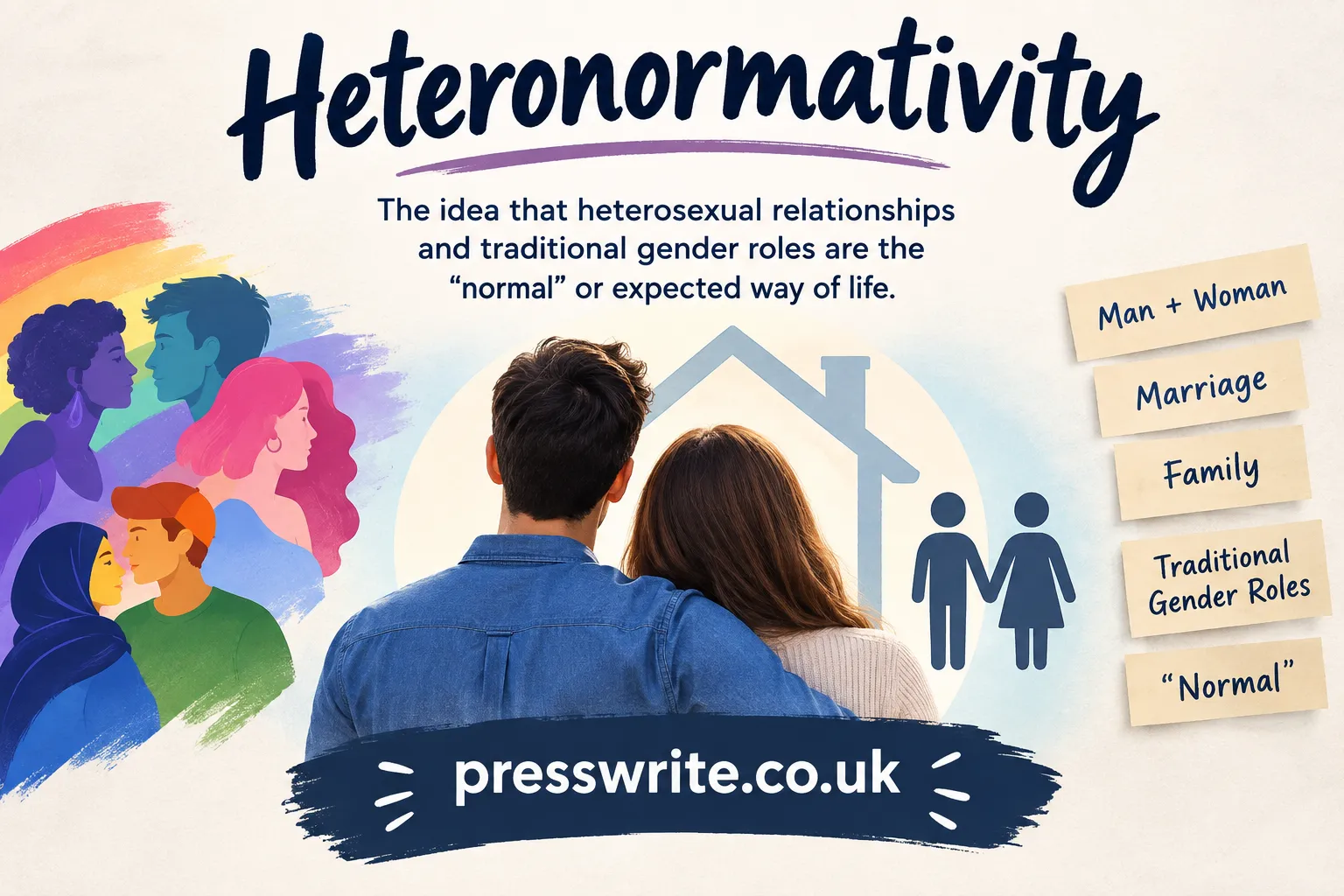
Heteronormativity is one of those words that sounds academic but describes something almost everyone has experienced, whether they realize it or not. It shapes the questions strangers ask you, the movies that get greenlit, the forms you fill out at the doctor’s office, and the assumptions baked into everyday conversation. Understanding heteronormativity isn’t just an exercise for sociology students — it’s a lens that helps explain why certain identities feel “default” while others constantly have to explain, justify, or defend themselves.
This article breaks down what heteronormativity actually means, where the concept came from, how it quietly operates inside our biggest institutions, and what it looks like to push back against it. Whether you’re encountering this term for the first time or you’ve read Judith Butler and want a refresher, this guide is built to meet you where you are.
What Is Heteronormativity? A Clear Definition
At its core, heteronormativity is the assumption that heterosexuality is the default, “normal,” or preferred sexual orientation, and that gender exists as a strict binary — male and female — which naturally aligns with specific roles, behaviors, and desires. It’s not simply the existence of heterosexual people or relationships; it’s the social system that treats heterosexuality as the unquestioned standard against which everything else is measured.
Sociologist Michael Warner is widely credited with popularizing the term in his 1991 essay collection on queer theory, though the underlying ideas draw on decades of feminist and gay liberation scholarship. Warner argued that societies don’t just tolerate heterosexuality — they actively organize institutions, laws, language, and culture around it, making other orientations and gender expressions seem like deviations rather than equally valid possibilities.
Where the Term Comes From
The concept didn’t appear overnight. It grew out of:
- Feminist theory, which had long examined how gender roles are socially constructed rather than biologically fixed.
- Gay and lesbian studies of the 1970s and 80s, which questioned why heterosexuality was treated as invisible while homosexuality was treated as something requiring explanation.
- Queer theory in the 1990s, which pushed further to question the categories of gender and sexuality themselves, not just the hierarchy between them.
Understanding this lineage matters because heteronormativity isn’t a standalone idea — it’s connected to broader conversations about power, visibility, and who gets to be considered “normal” in the first place.
How Heteronormativity Shows Up in Everyday Life
Heteronormativity rarely announces itself directly. It tends to operate through small, repeated assumptions that most people never pause to question.
Family Structures
From childhood, many people are exposed to a narrow script: grow up, find someone of the “opposite” sex, get married, have biological children. Fairy tales, greeting cards, and even tax forms have historically reinforced this template as the expected life path, treating any deviation as an exception that needs commentary.
Media Representation
Television, film, and advertising have long defaulted to heterosexual couples as the “safe” or “relatable” choice. Even when LGBTQ+ characters appear, they’re often sidelined into supporting roles, tragic arcs, or comic relief rather than being written as fully realized leads. This pattern shapes public perception by making heterosexual romance feel universal and everything else feel niche.
Education System
Sex education curricula in many countries have historically centered exclusively on heterosexual reproduction, leaving students with same-sex attractions or non-binary identities without relevant, accurate information about their own bodies and relationships.
Workplace Culture
Small moments — a colleague assuming your spouse is a different gender, health insurance forms with only two gender checkboxes, office small talk that assumes everyone is chasing an opposite-sex partner — all quietly signal who the workplace considers “standard.”
Heteronormativity vs Heterosexism: What’s the Difference?
These two terms are often used interchangeably, but they describe different mechanisms. The table below breaks down the distinction clearly.
| Aspect | Heteronormativity | Heterosexism |
| Definition | The assumption that heterosexuality is the default, natural state | The belief that heterosexuality is superior to other orientations |
| Nature | Structural and cultural | Attitudinal and often prejudicial |
| How it operates | Through invisible norms, institutions, and language | Through explicit bias, discrimination, or hostility |
| Example | A form that only offers “husband/wife” as options | A person openly stating gay relationships are “wrong” |
| Intent | Often unintentional or unconscious | Can be intentional or unintentional, but is judgmental |
| Where it’s found | Media, law, education, family norms | Individual attitudes, jokes, harassment, policy bias |
In short, heteronormativity is the water everyone swims in, while heterosexism is an active current pushing against those who don’t fit the mold. You can experience heteronormativity without any hostile intent involved — it’s simply the default setting society was built around.
The Social and Psychological Impact of Heteronormativity
The effects of growing up in, or navigating, a heteronormative culture extend far beyond abstract theory. They shape real emotional and social outcomes.
Impact on LGBTQ+ Individuals
- Constant self-explanation: Having to “come out” repeatedly, since heterosexuality is assumed by default.
- Internalized shame or confusion: Especially for those raised in environments with no visible representation of their identity.
- Mental health strain: Research has linked heteronormative pressure to higher rates of anxiety and depression among LGBTQ+ youth, largely due to lack of acceptance and visibility.
- Invisibility in healthcare: Doctors may fail to ask relevant questions because forms and training assume heterosexual patients.
Impact on Society at Large
Heteronormativity doesn’t only affect LGBTQ+ people — it also boxes in heterosexual and cisgender individuals by enforcing rigid expectations about masculinity, femininity, marriage timelines, and family structure. A man who doesn’t want children, or a woman who prioritizes career over marriage, can also face social friction rooted in the same normative script.
Heteronormativity in Major Institutions
To really understand how deep this concept runs, it helps to look at specific institutions where it plays out.
Law and Policy
For much of modern history, marriage laws, adoption rights, and even immigration policy were built exclusively around heterosexual couples. While many countries have expanded legal recognition of same-sex relationships, the underlying legal architecture — designed around a heterosexual template — often still requires retrofitting rather than being built inclusively from the start.
Religion
Many religious traditions have historically framed heterosexual marriage as not just preferred but divinely ordained, which has had a lasting influence on cultural attitudes even in secular institutions like schools and workplaces.
Religious Texts and Interpretation
It’s worth noting that interpretation varies widely even within single religious traditions, and many contemporary theologians and faith leaders actively challenge heteronormative readings of scripture, arguing that inclusion and compassion are equally central religious values.
Healthcare
- Medical intake forms often lack options beyond “male/female” or “husband/wife.”
- Training programs for healthcare providers have historically underrepresented LGBTQ+-specific health needs.
- Reproductive health education is frequently framed exclusively around heterosexual intercourse.
Queer Theory and the Challenge to Heteronormativity
Queer theory, as an academic field, exists largely as a direct response to heteronormative assumptions. Rather than simply asking for LGBTQ+ people to be included within existing norms, queer theorists ask a more fundamental question: why do these norms exist as fixed categories at all?
Key Thinkers in the Field
- Judith Butler, who argued gender is “performative” rather than an innate, fixed trait.
- Eve Kosofsky Sedgwick, who examined how the hetero/homo divide shapes broader cultural meaning.
- Michael Warner, who coined and popularized the term heteronormativity itself.
Their collective work suggests that dismantling heteronormativity isn’t just about tolerance — it’s about rethinking the categories society uses to sort people in the first place.
Signs You Might Be Encountering Heteronormative Bias
Recognizing heteronormativity in action is the first step toward addressing it. Watch for patterns like:
- Assuming someone’s partner is a different gender before they’ve said so.
- Using “boyfriend/girlfriend” language by default instead of neutral terms like “partner.”
- Forms or surveys that only offer binary gender and opposite-sex relationship options.
- Media or advertising that treats same-sex couples as a “special feature” rather than a normal inclusion.
- School curricula that never mention LGBTQ+ history, health, or relationships.
A Quick Self-Check Exercise
Next time you fill out a form, watch a commercial, or read a children’s book, ask: does this assume everyone is straight and cisgender? If the answer is yes, you’ve just spotted heteronormativity in the wild.
How to Challenge Heteronormativity: Practical Steps
Change doesn’t require grand gestures — it often starts with small, consistent shifts in language and awareness.
- Use inclusive language: Default to “partner” or “spouse” instead of gendered terms when you don’t know someone’s relationship details.
- Diversify media consumption: Actively seek out stories, books, and shows with well-developed LGBTQ+ characters and creators.
- Push for inclusive forms: Whether at work, school, or in healthcare settings, advocate for gender and relationship fields that reflect real diversity.
- Educate without assuming: Ask open-ended questions rather than assuming someone’s orientation or gender identity.
- Support inclusive policy: Stay informed about legislation affecting LGBTQ+ rights in family law, healthcare, and education.
Frequently Asked Questions (FAQ)
Is heteronormativity the same as homophobia?
No. Homophobia involves direct fear, dislike, or hostility toward LGBTQ+ people. Heteronormativity is more structural — it’s the assumption that heterosexuality is the default, which can exist even without any hostile intent.
Does heteronormativity only affect LGBTQ+ people?
No. It also pressures heterosexual and cisgender people to conform to rigid gender roles and life-stage expectations, such as marriage timelines or traditional family structures.
Is heteronormativity the same everywhere in the world?
No. Its intensity and expression vary widely by culture, religion, and legal system, though the underlying pattern of treating heterosexuality as default appears in most societies to some degree.
Can heteronormativity change over time?
Yes. Legal reforms, increased media representation, and shifting cultural attitudes have gradually reshaped heteronormative defaults in many parts of the world, though progress is uneven globally.
How is heteronormativity different from cisnormativity?
Heteronormativity centers on assumed sexual orientation (that everyone is straight), while cisnormativity centers on assumed gender identity (that everyone’s gender matches the sex they were assigned at birth). The two concepts overlap but describe distinct assumptions.
A Final Thought
Heteronormativity isn’t a villain to be defeated in a single sweeping move — it’s a pattern woven so deeply into daily life that most people only notice it when they, or someone they love, doesn’t fit inside it. Perhaps the more useful question isn’t whether heteronormativity exists, but how much of what we consider “normal” is actually just familiar. The line between the two is worth sitting with, because familiarity has a way of disguising itself as truth long after the world around it has already changed.